A timesheet is a structured physical or digital record used by employees and employers to document the exact time spent working on specific tasks, projects, or shifts over a set pay period. Timesheets track regular hours, overtime, rest breaks, and attendance to ensure accurate payroll calculation, client billing, and legal labor compliance.
Whether running a fast-growing software agency, managing a distributed BPO center, or coordinating hybrid shift workers, tracking time accurately is fundamental to operational success. For decades, organizations relied on physical paper punch cards or static Excel spreadsheets to log employee hours. Today, modern digital timesheets and employee timesheet software have transformed time tracking from a tedious administrative headache into an automated, error-free workflow.
In this in-depth guide, we explore everything you need to know about timesheets: what they are, how they work step-by-step, the different types available, exact calculation formulas, common pitfalls of manual tracking, and how automated employee monitoring software streamlines attendance and payroll with zero manual friction.
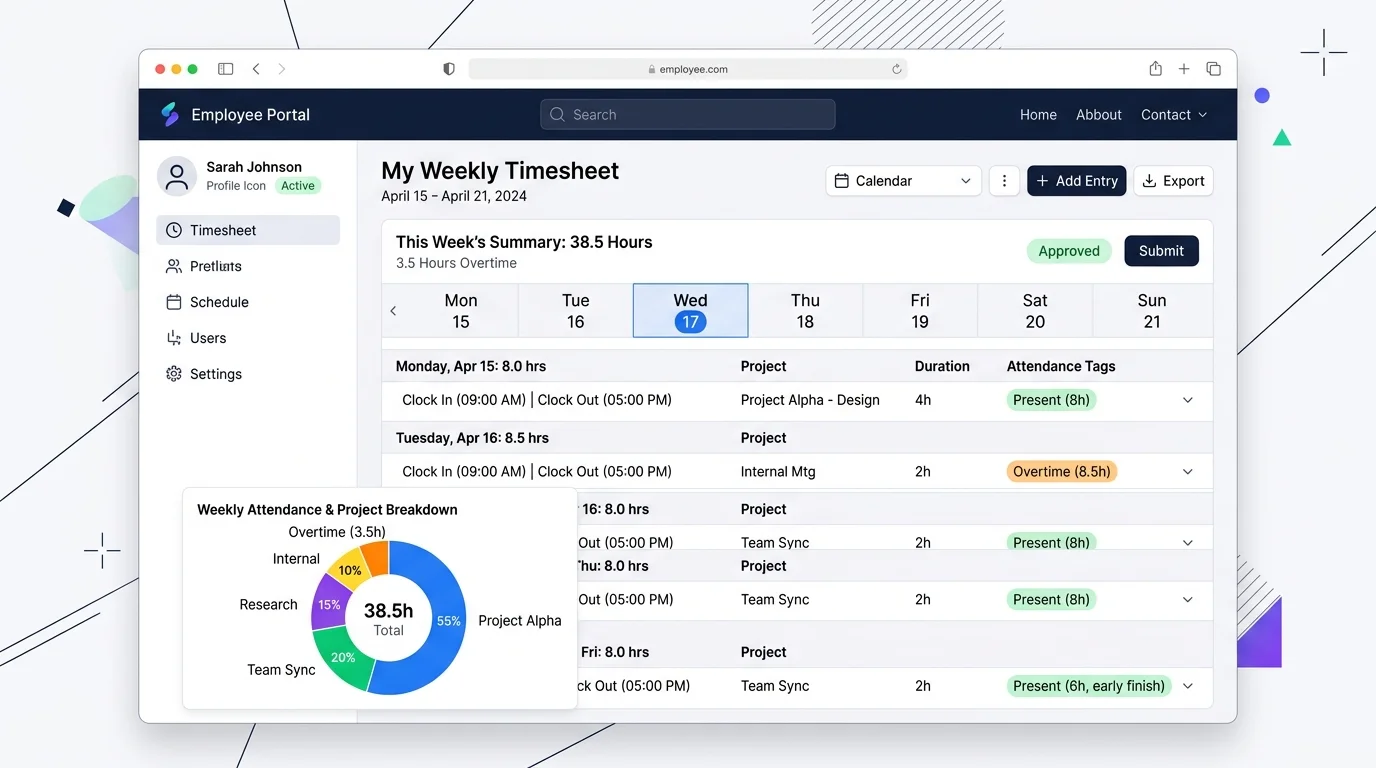
1. What Is a Timesheet and What Does It Contain?
At its core, a timesheet is a data record that captures an individual’s work duration across days, weeks, or months. Historically invented in the late 19th century during the industrial revolution as mechanical punch cards, timesheets have evolved into cloud-native databases that sync real-time productivity data across remote and on-premise teams via employee time tracking.
While formats differ across companies, every comprehensive employee timesheet contains several essential data elements:
- Employee Information: Full name, employee ID, department, role, and assigned manager or supervisor.
- Pay Period Dates: The exact date range covered by the timesheet (such as weekly, bi-weekly, semi-monthly, or monthly).
- Daily Timestamps: Exact start time (clock-in) and finish time (clock-out) for each calendar day worked recorded via attendance tracking software.
- Break & Meal Deductions: Duration of unpaid meal breaks or statutory rest periods tracked with idle time tracking software.
- Project & Task Codes: Specific client accounts, projects, tickets, or cost codes managed inside a project time tracker.
- Total Hours Category: Separation between standard regular hours and overtime (OT) hours based on company policy and local labor laws.
- Leave & Time-Off Tags: Recorded days for paid time off (PTO), sick leave, national holidays, or unexcused absences.
- Verification & Approvals: Digital signatures and timestamps enforced with role-based access control.
2. How Does a Timesheet Work? Step-by-Step Workflow
Understanding the end-to-end timesheet lifecycle clarifies why accurate time recording is vital across human resources, project management, and accounting departments. A standard timesheet process follows six sequential phases:
Step 1: Clock-In & Start of Shift
The employee begins work and logs their starting timestamp. In traditional offices, this was done via a wall clock or digital spreadsheet. In modern automated environments, an endpoint agent automatically detects computer startup or user authentication and clocks the employee in instantly according to their custom schedules.
Step 2: Activity & Task Allocation
Throughout the workday, the employee records time spent against specific projects, client retainers, or internal tasks. With employee app and URL tracking, managers assess software utilization, billable vs non-billable ratios, and task completion velocity.
Step 3: Break Logging & Clock-Out
When taking statutory meal breaks or concluding the daily shift, timestamps are captured to calculate gross daily hours worked minus non-billable break durations.
Step 4: Submission at End of Pay Period
At the close of the pay cycle (commonly every Friday or bi-weekly), the employee reviews their aggregated hours, verifies accuracy, and submits the completed timesheet to their supervisor for review.
Step 5: Manager Review & Dispute Resolution
The supervisor examines the timesheet against scheduled shifts, project deliverables, and attendance rules. If discrepancies arise, managers review time tracker with screenshots or time and activity tracking logs before granting formal approval.
Step 6: Payroll Processing & Invoicing
Once approved, the verified timesheet data exports directly to automated payroll software to generate employee payslips and to time tracking and invoicing software to bill clients for billable hours.
3. The 3 Main Types of Timesheets Compared
Timesheet methodologies range from basic paper documents to fully autonomous cloud systems. Choosing the right system depends on team size, working model (office vs remote), and compliance requirements.
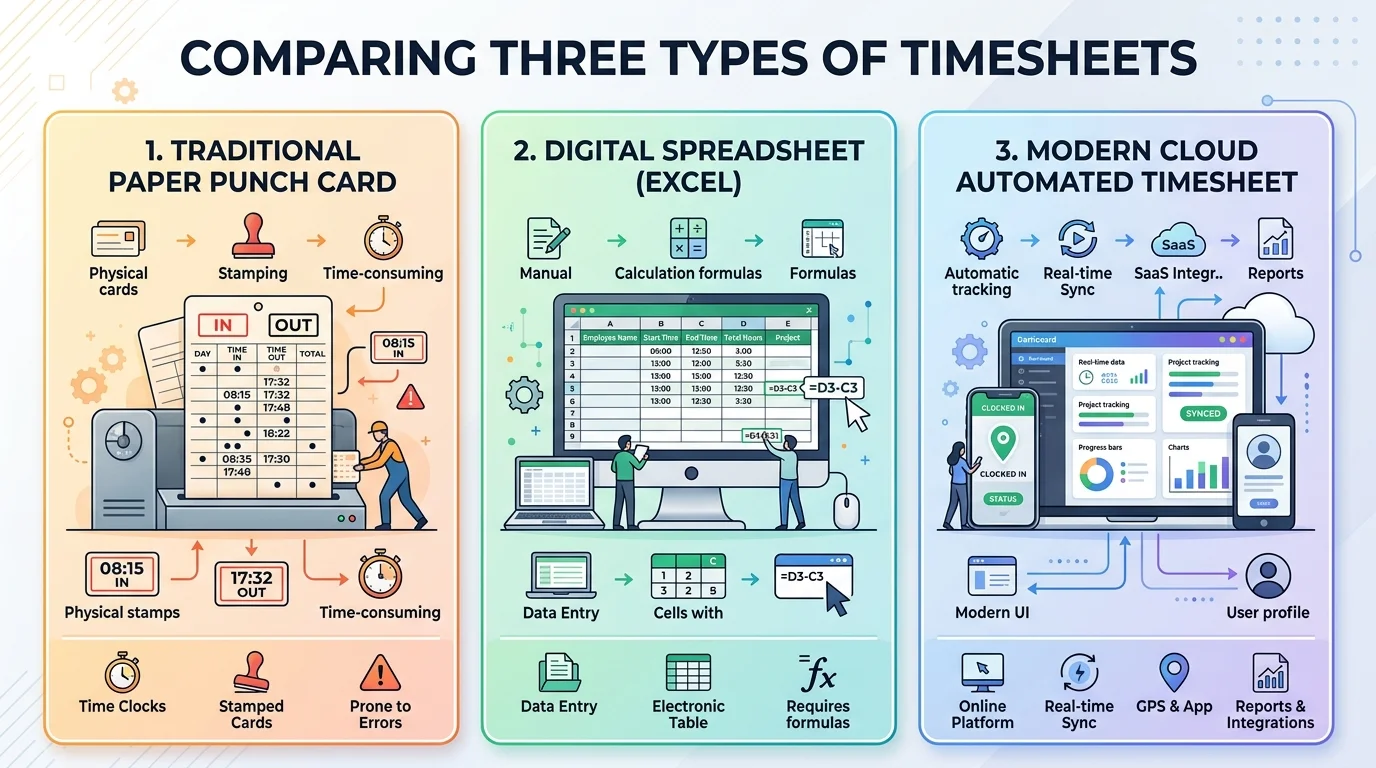
1. Traditional Paper Timesheets & Punch Cards
Physical paper cards or sign-in logbooks require employees to manually write timestamps or stamp a punch card using a mechanical time clock. While simple to introduce without computers, paper timesheets are vulnerable to physical damage, manual calculation errors, illegible handwriting, and "buddy punching" (where one worker clocks in on behalf of an absent colleague).
2. Digital Spreadsheet Timesheets (Excel / Google Sheets)
Electronic spreadsheets use pre-built mathematical formulas (like =(End_Time - Start_Time) * 24) to tally daily hours automatically. While a significant upgrade from paper, spreadsheets still rely entirely on human memory and manual data entry. Employees often fill them out at the end of the week, leading to inaccurate guesswork and accidental formula overwrites.
3. Automated Cloud Timesheet Software
Modern cloud solutions utilize lightweight desktop and mobile agents that record start times, shift attendance, active applications, screenshots, and idle periods automatically. Timesheets are generated in real time, eliminating manual data entry, preventing time theft with anti-bypass protection, and syncing directly with payroll engines.
| Feature / Criterion | Paper Timesheets | Excel Spreadsheets | Automated Software |
|---|---|---|---|
| Data Entry | 100% Manual (Handwritten) | Manual (Typing in cells) | 100% Automated Background Sync |
| Error & Math Rate | High (Human math mistakes) | Moderate (Broken formulas) | Near 0% (Precision timestamps) |
| Buddy Punching Risk | High (Zero identity check) | High (Shared passwords) | Zero (Hardware & Agent integrity) |
| Idle Time Filtering | None | None | Automatic (30s – 10m thresholds) |
| Admin Processing Time | 5–8 hours / pay period | 2–4 hours / pay period | Under 5 minutes (1-Click Export) |
| Remote Team Fit | Unusable for remote | Basic / Fragmented | Built for remote & hybrid BPOs |
4. Why Businesses Use Timesheets: 7 Critical Benefits
Far from being just an attendance monitoring tool, timesheets serve as the analytical backbone for operational efficiency, legal safety, and financial health:
- Accurate, Dispute-Free Payroll: Timesheets guarantee that hourly employees are compensated for every minute worked, while preventing overpayments caused by unverified estimates.
- Transparent Client Invoicing: For agencies, law firms, and consulting companies, timesheets paired with proof-of-work visual screenshots provide verifiable evidence in time reports for retainer and hourly invoices.
- Accurate Project Costing & Estimation: Historical timesheet data reveals the true labor hours required for specific deliverables, empowering leadership using project cost tracking software to quote future client contracts with precision.
- Strict Labor Law & FLSA Compliance: Wage and hour regulations (such as the US Fair Labor Standards Act and European Working Time Directives) require employers to keep accurate records of non-exempt employee work and overtime hours.
- Eliminating Idle Bottlenecks: Analyzing timesheet task distributions with workforce analytics exposes time-draining administrative overhead, unproductive meetings, and unbilled idle gaps.
- Automated Leave & PTO Tracking: Integrated timesheets track accrued vacation, sick leave, and casual time off without requiring separate offline spreadsheets.
- Resource Capacity Planning: Department heads can identify overworked team members at risk of burnout and redistribute workloads across remote workforce software.
5. How to Calculate Timesheet Hours & Overtime
Calculating timesheet hours manually requires converting minutes into decimal fractions so they can be multiplied by hourly pay rates. Here is the standard conversion methodology:
Decimal Hours = Total Minutes / 60
• 15 Minutes = 0.25 Hours | • 30 Minutes = 0.50 Hours
• 45 Minutes = 0.75 Hours | • 60 Minutes = 1.00 Hour
Practical Example: Calculating a Daily Shift
Suppose an employee has the following daily schedule:
- Clock In: 09:00 AM
- Lunch Break Start: 01:00 PM
- Lunch Break End: 01:45 PM (45 minutes unpaid break)
- Clock Out: 06:15 PM
Step 1 (Gross Time): From 9:00 AM to 6:15 PM = 9 hours and 15 minutes.
Step 2 (Deduct Break): 9 hours 15 mins − 45 mins break = 8 hours and 30 minutes net work.
Step 3 (Convert to Decimal): 30 minutes / 60 = 0.50. Net hours = 8.50 decimal hours.
Step 4 (Calculate Pay): If pay rate is $20/hour: 8.50 × $20 = $170.00 gross pay.
Overtime Calculation (FLSA 40-Hour Rule)
In most jurisdictions, any hours worked by non-exempt employees beyond 40 hours in a 7-day workweek must be compensated at 1.5× their regular hourly rate (time and a half). Automated timesheet software flags overtime thresholds in real time, preventing unexpected payroll overruns.
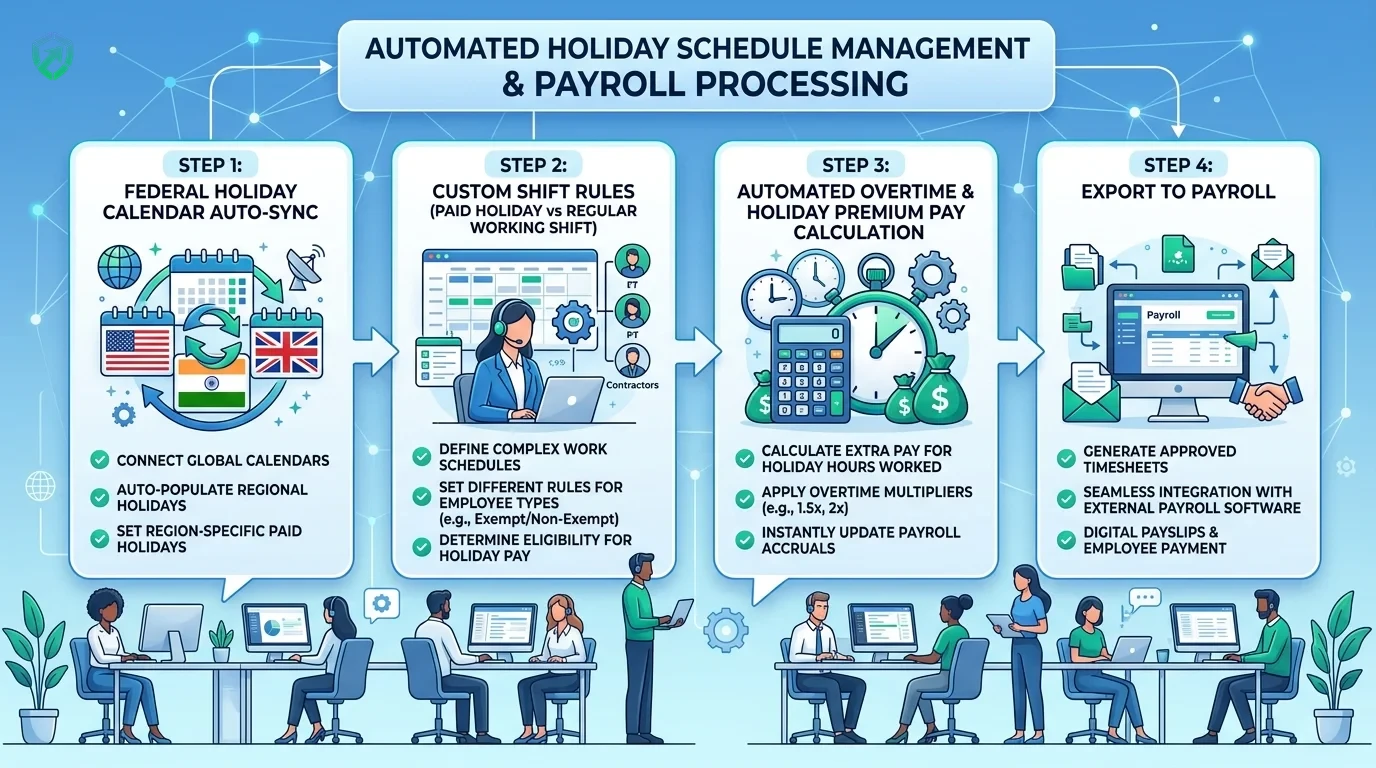
6. The Hidden Costs of Manual Timesheets vs Automated Software
Many businesses underestimate the real financial loss caused by outdated timesheet practices. According to industry studies by the American Payroll Association:
- Time Theft & Rounding: Employees casually rounding up 10–15 minutes per shift costs companies an estimated 2% to 5% of total payroll annually.
- Administrative Burden: HR managers spend an average of 4 to 6 minutes auditing and correcting every single manual timesheet paper card or spreadsheet cell.
- Late Timesheets: Unsubmitted timesheets delay invoice generation, negatively impacting business cash flow and client relationships.
By switching to automated employee monitoring and timesheet software like Tracknesty, remote teams, software developers, marketing agencies, and BPOs eliminate these overheads entirely. The desktop agent automatically records daily check-ins, filters out inactive idle periods, blocks mouse jigglers, captures proof-of-work screenshots, and stores compliance archives safely in team cloud storage.
7. Frequently Asked Questions About Timesheets
What is a timesheet in simple terms?
A timesheet is a physical document, spreadsheet, or digital software record used by employees and employers to record the exact time spent working on specific tasks, projects, or shifts over a given pay period.
What is the primary purpose of an employee timesheet?
The primary purpose of a timesheet is to accurately document working hours for payroll calculation, client billing, project cost tracking, and legal compliance with wage and labor regulations.
What is the difference between an exempt and non-exempt employee timesheet?
Non-exempt employees are legally entitled to overtime pay and must record exact daily start, end, break, and overtime hours. Exempt employees receive a fixed salary regardless of hours worked, but often track timesheets for project allocation and client billing.
What are 3 types of timesheets?
The 3 primary types of timesheets are: 1) Traditional Paper Punch Cards (physical cards stamped with mechanical clocks), 2) Digital Spreadsheet Timesheets (Excel/Google Sheets filled manually by staff), and 3) Cloud Automated Timesheet Software (automatic background tracking with zero manual data entry).
What is the meaning of a timesheet in accounting?
In managerial accounting, a timesheet is a primary source document used to allocate direct labor costs, calculate Cost of Goods Sold (COGS), measure project profitability, and recognize billable client revenue accurately.
What information is required on an employee timesheet?
A legally compliant timesheet requires: employee name & ID, pay period dates, exact daily clock-in and clock-out timestamps, unpaid meal break durations, project/task allocation codes, regular vs overtime hours calculation, and employee/supervisor signature verification.
Is it spelled timesheet or time sheet?
Both spellings are correct and widely used. "Timesheet" (as a single compound word) is the prevailing industry standard in HR, software, and accounting documentation, while "time sheet" (as two words) is also recognized as grammatically valid.
What are the functional requirements of an electronic timesheet system?
The key functional requirements of an electronic timesheet system include automated timestamp capture, idle time deduction, anti-bypass fraud detection, role-based approval workflows, overtime multiplier rules, audit logging, and direct integration with automated payroll software.
How long must employers keep timesheet records by law?
Under the US Fair Labor Standards Act (FLSA), employers must retain payroll records and timesheets for at least 3 years, and supplementary time cards or schedules for at least 2 years.
How do you convert timesheet minutes into decimal hours for payroll?
Divide the number of minutes worked by 60. For example, 15 minutes = 0.25 hours, 30 minutes = 0.50 hours, and 45 minutes = 0.75 hours. An 8 hour and 30 minute workday equals 8.5 decimal hours.
What is an automated digital timesheet?
An automated timesheet is a cloud-based software solution that tracks employee start and stop times, active application usage, shift attendance, and idle periods automatically in the background without requiring manual data entry.
How does automated timesheet software detect idle time?
Automated timesheets monitor keyboard and mouse activity thresholds without recording private keystrokes. If an employee is away from their keyboard for longer than the set limit (e.g., 5 minutes), the idle time is automatically deducted from active work hours.
How do automated timesheets connect directly to payroll?
Once approved by a supervisor, verified timesheet hours, overtime multipliers, and deductions transfer seamlessly into automated payroll to generate 1-click payslips and bank disbursements.
8. Conclusion: Upgrading Your Workforce Timesheet Process
A timesheet is much more than a clock-in log—it is a vital operational tool that impacts payroll accuracy, project profitability, labor compliance, and employee trust. While paper and spreadsheets served businesses in the past, modern distributed teams require real-time, automated solutions that eliminate manual friction and errors.
Ready to replace manual timesheet headaches with instant, automated workforce analytics? Discover how Tracknesty simplifies employee monitoring, automated attendance, and screenshot verification for remote teams and BPOs.